1994 marked the 25th anniversary of British troops being sent on to the streets of the north of Ireland, and there were demonstrations in London, Belfast, and Dublin on the theme of '25 years - time to go, time for peace'.
London, 13 August 1994
In London the Troops Out Movement and other groups including the Irish in Britain Representation Group held a march from the park by the Imperial War Museum. Black balloons were released to mark the dead of the conflict and a coffin taken to Downing Street labelled 'Britain's War: 25 years - 3400 dead'. Around 3,000 people took part.
 |
| A sticker for the demo |
 |
| Black balloons released over Westminster |
 |
| 'Troops Out' magazine, August/September 1994 |
Belfast, 14 August 1994
In Belfast the next day there was another demonstration, with thousands of people converging on City Hall in parades from all parts of the city. The largest contingent came from West Belfast, where 'The march proceeded to the Whiterock Road where the Ballymurphy section of the march joined them. Several of the visiting delegations were with this section of the march. There were contingents from Noraid, from the Basque country, from Italy as well from the Troops Out Movement and many other solidarity groups' (An Phoblact, 18 August 1994). Speakers at the end of the march included Sinn Fein president Gerry Adams.
 |
| 'Falls/Clonard: 25 years of resistance' - mural in Dunville Street off the Falls Road in Belfast |

'Free the Ballymurphy Seven' - the campaign in support of seven young men who were arrested following a bomb attack on an army patrol in 1991. They were charged on the basis of 'confessions' obtained under duress in Castlereagh interrogation centre. Eventually all were acquitted but not after spending several years in prison.
 |
| 'Cheering marchers say Britain Must Go', An Phoblact, 18 August 1994 |
Dublin, 20 August 1994
The march in Dublin on the following Saturday 20th August was one of the largest pro-republican rallies there since the 1981 hunger strikes. Over 10,000 people took part in what was billed as a parade and pageant rather than just a traditional demo. There was street theatre and more than 54 floats highlighting current and historic issues. The Wolfe Tones played to the crowd gathered by the GPO, and of course there were various republican flute bands including the Spirit of Freedom, Sliabh Dubh, Gleann an Lagain and Tom Smith.

 |
| The Angel of Death leads the march |
 |
| 'Get out of my sight!' |
 |
| A float highlighting Fermanagh/Monaghan border posts |
 |
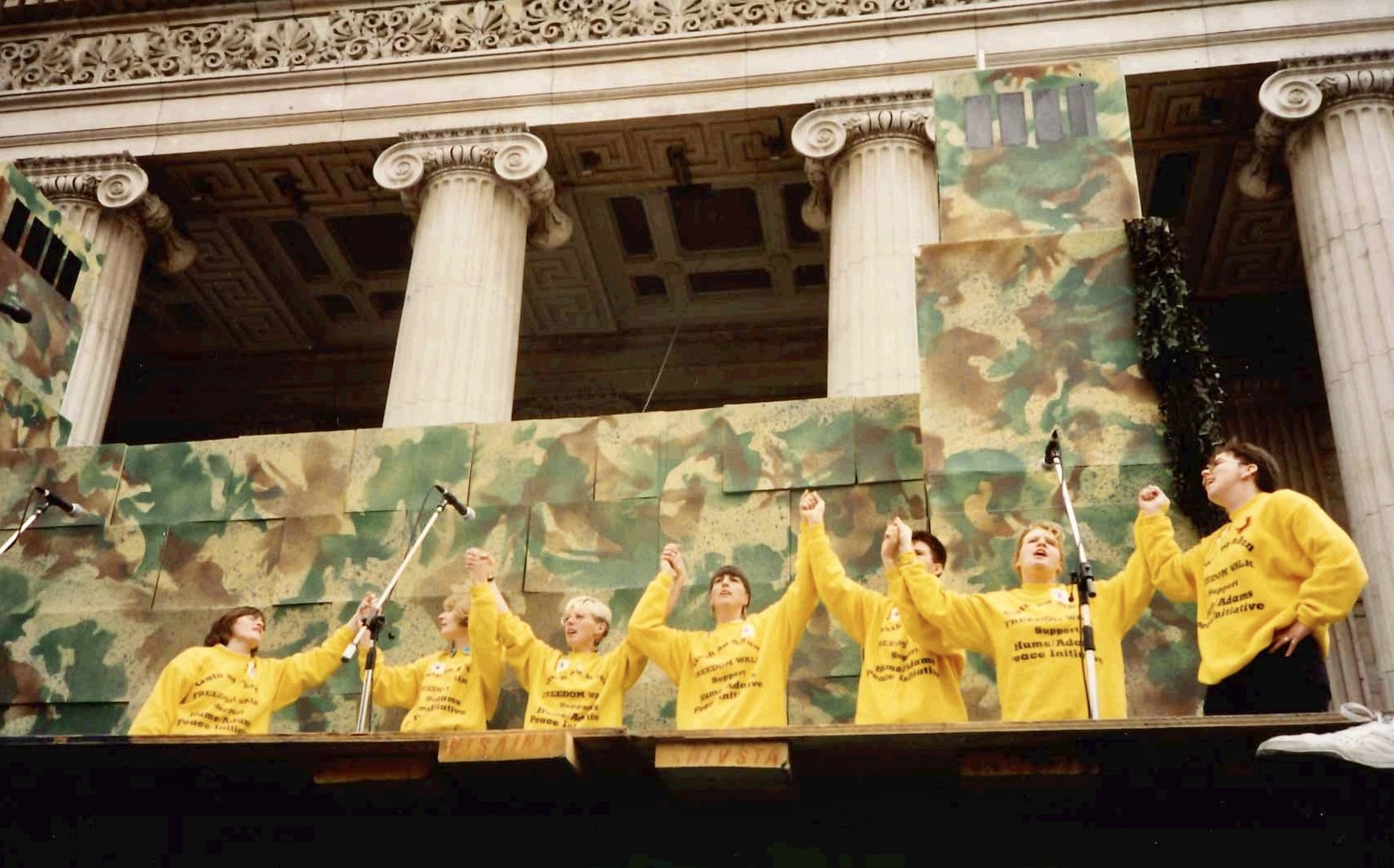
| 'Guth na mBan' singing 'Something inside so strong' |
 |
| The Dublin and Monaghan bombs in 1974 killed 33 people and were planted by the Ulster Volunteer Force with the knowledge of British intelligence |
 |
| At the GPO |
 |
| 'Slán abhaile' (Safe Home) |
 |
| An Phoblact, 25 August 1994 |
 |
A summary of other Time to Go events including in Derry, Crossmaglen, Newry and around the world
(An Phoblact, 18 August 1994) |
1994 was a key turning point in the conflict. The year before Gerry Adams and John Hume had launched the Irish Peace Initiative, and then on 31 August 1994 the Irish Republican Army announced a ceasefire. After several years of a stop and start process the Good Friday Agreement was signed in Easter 1998, paving the way for demilitarisation and prisoner release.
Anyway that was a busy week for me, rushing from London to Belfast then travelling around Ireland towards Dublin. Stopping off in Sligo for a banging house club night in a hotel back room full of people celebrating on the day of their Higher exam results. Where was that I wonder?
[I recently donated some photos and papers to the MayDay Rooms in London for their archive of Troops Out Movement and related materials. If you have anything you can share with them get in touch with them. This post is one in a series where I contextualise this material with my recollections]
See also:
 |
'Time for Peace, Time to Go'
(I did think this photo might have been from Dublin, but seems it's actually Albert Square in Manchester, so this must have been on the Bloody Sunday demo there in January 1995)
|